Choosing the right China Best Custom OEM Sportswear Manufacturer for Brands requires more than comparing factory prices. Brands need a partner that understands performance fabrics, accurate sizing, stable production, and real customer expectations. A reliable custom OEM sportswear manufacturer should turn technical concepts into wearable products, from breathable training tops to compression leggings and team jackets. The process often begins with fabric selection, measurement charts, logo placement, and a detailed sample review. Small details matter. A misplaced seam can cause friction. A weak zipper can damage the entire product experience.
Experienced manufacturers usually provide development support, material suggestions, prototype samples, and production quality checks. However, no supplier is perfect. Sample colors may change slightly between screens and fabric batches. Delivery plans can also shift when materials become unavailable. Honest communication is more valuable than impressive promises. Brands should request clear specifications, inspect samples, confirm testing standards, and review production records before placing larger orders. Factory visits, independent inspections, and documented quality procedures can strengthen trust.
Strong sportswear production also depends on responsible sourcing and transparent working practices. Manufacturers should explain their capabilities clearly, including minimum order quantities, lead times, packaging options, and after-sales support. A professional team will discuss what may fail, not only what looks attractive. This practical attitude reflects genuine experience. It helps brands reduce waste, control costs, and create products that perform during repeated washing, running, training, and competition. The best partnership is not always the cheapest one. It is the one that consistently protects quality, communication, and brand reputation.
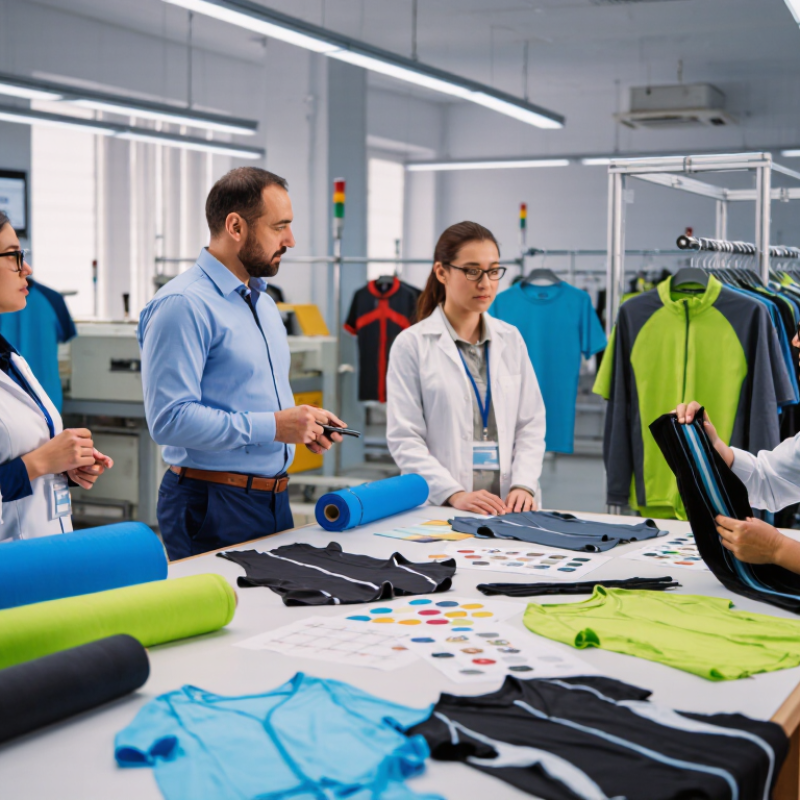
Choosing a China custom OEM sportswear manufacturer requires more than comparing prices. OEM means your team provides the design, specifications, labels, and performance requirements. The manufacturer then produces the garments to your approved standard. ODM is different. The factory offers existing designs that you can modify with colors, fabrics, logos, or measurements. ODM can reduce development time, but it may limit product uniqueness.
For global brands, the right model depends on control, budget, and launch speed. OEM suits teams with detailed tech packs, tested size charts, and clear fabric expectations. ODM works better when the product concept is simple and timing is tight. Ask for fabric composition, colorfastness results, stitching samples, and production tolerances. A sample may look excellent, yet bulk production can reveal uneven seams or slight color variation. That is not always failure, but it requires honest inspection and corrective action. A cheaper quote is not always a better decision.
Tips: Send a complete tech pack. Define acceptable measurements. Request a pre-production sample. Confirm packaging and labeling rules for each market. Keep written records of every approval. Do not rely on friendly promises alone. Review the factory’s quality process, communication speed, and ability to repeat the same result. There is room for improvement in every supply chain, including yours.
The chart compares common apparel-sourcing planning benchmarks. OEM production is typically more flexible for proprietary designs but may require longer development and higher minimum quantities. ODM programs generally shorten development time by using existing product platforms, while customization options are more limited. Actual lead times and MOQs vary by fabric, technology, order complexity, and factory capacity.
Reference basis: commonly published apparel sourcing benchmarks from international manufacturing and trade-practice guides; figures are indicative planning ranges rather than company-specific quotations.
China can be a strong custom sportswear manufacturing base, but supplier evaluation should begin with evidence, not attractive catalog photos. The World Bank’s 2023 Logistics Performance Index ranked China 19th among 139 economies, with a 3.7 score. This supports reliable export infrastructure, although factory performance still varies by region and product type.
Ask for a written production schedule. A realistic 30–60-day lead time should separate fabric booking, sampling, cutting, sewing, quality inspection, and shipment. A factory promising 30 days may exclude fabric delays. Confirm whether the clock starts after deposit, artwork approval, or sample confirmation. Request recent capacity records, daily output, overtime limits, and machine lists. The International Labour Organization highlights working-time and occupational-safety controls as essential manufacturing considerations. Capacity is not only a number.
MOQ deserves the same scrutiny. One style may require 300 pieces, while custom dyeing or printed fabric may require 1,000 or more. Ask whether MOQ applies per color, size, or total order. Compare this with your forecast, storage space, and cash flow. The U.S. Fashion Industry Association’s 2024 Fashion Industry Benchmarking Study continues to identify sourcing diversification and supply-chain visibility as major industry priorities. That matters in practice. I would still request a small pilot order, even when the factory appears experienced. It may reveal uneven stitching, shade differences, or weak measurement control. Supplier claims are useful, but inspection records and production samples are stronger evidence.
A reliable custom OEM sportswear manufacturer starts with fabric engineering, not surface appearance. GSM measures fabric weight per square meter, and it affects coverage, drape, warmth, and drying speed. A 140 GSM training top may feel light and breathable. A 220 GSM compression short can offer stronger structure. However, GSM alone cannot predict comfort. Fiber type, knitting method, and finishing change the final result.
Four-way stretch should be tested in both length and width. During sampling, we measure extension, recovery, and seam stability after repeated pulls. A fabric may stretch easily but recover slowly around the knees. That creates sagging after several training sessions. Not ideal. We also inspect movement under practical conditions, such as squats, sprints, and overhead reaches. Laboratory figures help, but real movement often reveals weaknesses.
Moisture-wicking performance depends on fiber construction and skin contact. A smooth inner surface can move sweat toward the outer face, where evaporation is faster. We check drying time after controlled moisture application, then compare results after washing. Heat, detergent, and fabric softener can affect performance. This detail is sometimes overlooked. We should admit that no fabric performs perfectly in every climate. A lightweight blend may dry quickly but offer less opacity. A heavier knit may feel secure but hold more heat. Clear testing records and honest limitations help create better sportswear decisions.
Quality in custom sportswear begins with a controlled production system, not attractive samples alone. An ISO 9001-based factory documents each step, from fabric receiving to final packing. Technicians record fabric weight, color shade, stretch recovery, and seam strength. These records make problems traceable.
Small details matter. AQL 2.5 inspections use random samples from finished cartons. Inspectors check measurements, stitching, print placement, stains, and loose threads. This level does not mean every garment is perfect. Sampling has limits. A failed inspection should trigger correction, not rushed shipment.
REACH testing adds another layer of protection for materials entering regulated markets. Independent laboratory reports can assess restricted substances in dyes, prints, trims, and coated fabrics. Reliable manufacturers keep test records linked to production batches. They should also verify changes in fabric suppliers or chemical formulas. I have seen minor trim substitutions create avoidable compliance questions. That experience supports a practical rule: approve every material before bulk cutting, and review the evidence before production begins. Testing costs time, but missing documentation can cost far more.
| Quality & Compliance Dimension | Standard / Benchmark | What It Covers | Recommended Verification Evidence | Practical Buyer Consideration |
|---|---|---|---|---|
| Quality management system | ISO 9001:2015 | Defines requirements for a documented quality management system, including process control, customer focus, corrective action, and continual improvement. | Valid certificate issued by an accredited certification body; certificate scope should cover the relevant manufacturing activities and site. | ISO 9001 certification supports consistent processes, but it does not by itself guarantee that every garment will meet a specific design or performance requirement. |
| Pre-production control | Approved specification and pre-production sample | Confirms measurements, construction details, fabric composition, color references, trims, labeling, packaging, and decoration artwork before bulk production. | Signed technical pack, approved sample, fabric approvals, artwork approval, and documented change-control records. | Clear written specifications reduce interpretation errors and make final inspection criteria measurable. |
| In-line quality inspection | Documented inspection checkpoints | Checks fabric defects, cutting accuracy, sewing quality, seam construction, workmanship, printing or embroidery, and measurement consistency during production. | In-line inspection reports, defect photographs, measurement records, and corrective-action records. | Early detection generally reduces rework and helps prevent repeated defects from reaching final inspection. |
| Final random inspection | AQL 2.5 for major defects, when specified by the buyer | Uses a defined sampling plan to assess whether the inspected lot meets agreed acceptance criteria for major defects. | Inspection report showing lot size, sample size, sampling standard, defect classification, acceptance and rejection numbers, and results. | AQL 2.5 is an acceptance sampling parameter, not a claim that 2.5% of all garments are automatically acceptable. The sampling plan and defect definitions must be agreed in advance. |
| Defect classification | Critical, major, and minor defects | Separates safety or legal risks from defects that affect function, appearance, fit, or commercial acceptability. | Buyer-approved defect list with examples, severity definitions, and acceptance limits. | Critical defects normally require zero acceptance; exact limits for major and minor defects depend on the purchase specification and sampling plan. |
| Chemical compliance | EU REACH Regulation (EC) No 1907/2006 | Controls chemicals of concern in articles and substances placed on the EU market, including applicable restrictions and substances of very high concern. | Recent laboratory test reports linked to the actual fabric, print, coating, accessories, and production lot; supplier declarations and material documentation. | REACH obligations depend on the product, materials, substances, intended market, and applicable restrictions. A general statement of compliance is not a substitute for relevant testing. |
| Textile composition accuracy | Declared fiber composition must match the tested material | Verifies that fiber content shown on product labels and technical documents is consistent with the actual textile composition. | Laboratory fiber-composition report and approved labeling artwork. | Labeling requirements vary by destination market; composition should be checked before bulk labels are produced. |
| Colorfastness performance | Test method and pass criteria agreed before production | May include colorfastness to washing, rubbing, perspiration, water, and light, depending on the garment's intended use and material. | Laboratory report identifying the exact fabric or finished garment, test method, rating, and acceptance requirement. | Dark colors, high-elastane fabrics, prints, and performance finishes may require additional testing based on the product risk profile. |
| Dimensional stability | Buyer-approved shrinkage and measurement tolerances | Evaluates dimensional change after the specified care process and confirms that finished measurements remain within tolerance. | Wash-test report, before-and-after measurements, care instructions, and size-specification comparison. | Wash conditions must reflect the care label and intended consumer use; tolerance limits should be defined by garment area and size. |
| Functional sportswear testing | Product-specific performance requirements | Can include moisture management, stretch and recovery, pilling resistance, seam strength, bursting strength, abrasion resistance, and print adhesion. | Independent or qualified laboratory reports using stated test methods and samples representative of bulk production. | Testing should be selected according to the sport, fabric technology, construction, and claims made in product marketing. |
| Traceability and corrective action | Lot identification and documented CAPA process | Links raw materials, production batches, inspections, test reports, nonconformities, root-cause analysis, and corrective actions. | Batch records, production logs, inspection history, nonconformity reports, and corrective-action verification. | Traceability improves the ability to isolate affected goods and verify that corrective actions are effective. |
| Shipment release decision | Documented approval against agreed requirements | Confirms that finished goods meet the approved sample, measurements, workmanship standard, packaging instructions, labeling requirements, and applicable compliance criteria. | Final inspection report, test documentation, packing list, approved shipment sample, and release authorization. | Shipment approval should be based on objective records rather than certification status alone. |
For brands seeking a China custom OEM sportswear manufacturer, FOB pricing requires careful review. FOB usually covers production, export clearance, and delivery onboard the vessel. It excludes ocean freight, insurance, import duties, and destination transport. A low FOB quote can therefore hide a higher landed cost. Ask for fabric weight, trim costs, packaging, minimum order quantities, and payment terms.
Sampling is another cost and sustainability factor. A proper sample should test fit, color, stretch recovery, stitching, and wash performance. Requesting five rushed revisions creates fabric waste and extra courier emissions. Small samples matter. A digital pattern review can reduce unnecessary prototypes, although it cannot replace physical testing completely. Textile Exchange’s Materials Market Report 2024 reported 124 million tonnes of global fiber production in 2023, with output projected to reach 160 million tonnes by 2030. That scale makes every avoidable sample relevant.
ISO 14001 can strengthen factory evaluation, but certification is not proof of sustainable clothing. It confirms an environmental management system, including controls, objectives, audits, and continual improvement. ISO’s 2023 Survey provides a useful reference for checking certified sites and certificate scope. Ask to verify the certificate, issuing body, site address, and expiry date. A spreadsheet can still lie. Factory records should show energy use, wastewater controls, chemical handling, and corrective actions. The imperfect part is unavoidable: sustainability data may be incomplete, inconsistent, or manually recorded. That weakness should be disclosed before approving the FOB quote.
Ask for evidence, not only polished catalog images. Review production samples, inspection records, capacity data, and written schedules. Photos can mislead.
It should cover fabric booking, sampling, cutting, sewing, inspection, and shipment. Confirm when the timeline begins. Is it after payment, artwork approval, or sample confirmation?
Request daily output, recent production records, machine lists, and overtime limits. Capacity is more than a number. Check whether current orders affect your schedule.
Ask whether the MOQ applies per style, color, size, or total order. Custom dyeing and printed fabric may require higher quantities. One style might need 300 pieces.
A pilot order can expose uneven stitching, shade differences, or poor measurement control. It costs time. Still, it may prevent larger mistakes.
GSM measures fabric weight per square meter. A 140 GSM top may feel light and breathable. A 220 GSM short may provide more structure. GSM alone does not predict comfort.
Test stretching in both length and width. Measure extension, recovery, and seam stability after repeated pulls. A fabric may stretch well but recover slowly around the knees.
Apply a controlled amount of moisture and measure drying time. Repeat the test after washing. Detergent, heat, and softener can change results. Real movement matters too.
Choosing the right custom OEM sportswear manufacturer is essential for global brands seeking reliable quality, flexible production, and competitive pricing. This guide explains the difference between OEM and ODM services, helping buyers determine whether they need fully specified products or support with design and development. It also outlines key evaluation factors, including minimum order quantities, typical 30–60-day lead times, production capacity, communication, and sampling procedures.
Technical performance is equally important. Buyers should review fabric GSM, four-way stretch, breathability, and moisture-wicking capabilities to ensure products meet functional expectations. Quality management should include ISO 9001 systems, AQL 2.5 inspection standards, and REACH-related material testing. Finally, the article considers FOB pricing, sample costs, production efficiency, and sustainability practices such as ISO 14001 environmental management. Together, these criteria provide a practical framework for selecting a capable, transparent, and long-term manufacturing partner.